
Qualified Enough to Interview. Too Qualified to Hire.
Sound familiar?

A man protected his money. I catapulted a woman’s career.
That’s the shortest version of the story.
I saw her post recently. I wasn’t looking for anything in particular — you know how it goes, you scroll, a face you haven’t thought about in a long time surfaces, and suddenly you’re curious. I clicked on her profile because I wanted to see how long she’d been at that company. The one she went to after we both left where we were.
Thirteen years and nine months. Wow!
I sat with that number for a minute. Thirteen years and nine months is not a job. It’s a career. It’s a mortgage. It’s a retirement account. It’s the kind of tenure people don’t get anymore — the kind of stability that shapes a whole life.
And I remembered exactly how she got there.
Years ago, a recruiter called me about a role I wanted. The kind of position where the work, the money, the trajectory all lined up, and I knew it the minute I read the description.
First interview went well. Better than well. They were gung-ho. They wanted to move me forward so fast that they flew me to New York to meet their outside counsel, an employment attorney the company had on retainer. The meeting was, everyone told me, a formality — the last box to check before the job was officially mine
I flew up. I sat across from him. And we started talking.
Here is the thing probably no one had fully thought through before they booked that flight: employment law is my language.
Not adjacent to my language.
Not something I’d studied once.
My language.
I had been an employment trial lawyer - an exceptional one - for over a decade at that point. So when he started walking me through what he did for the company, we didn’t stay in a briefing. We moved into a conversation. Peer to peer. I met him where he was and kept pace, and then some. I wasn’t nodding along. I was engaged, fluent, in it with him.
And somewhere in the middle of that conversation, he realized what was sitting across from him. Not a curiosity. Not a junior hire he could manage around. A peer. A highly capable one. Someone who could do his job, had done his job, and was about to do his job inside the company that was currently paying him to do it.
That scared the shit out of him.
I knew — maybe before he did — exactly how much of his work would quietly disappear the day I walked into that company full-time.
I thought the meeting went beautifully. I left New York excited. I flew home convinced the job was mine.
It wasn’t.
A few days later, the recruiters called me sounding like they’d seen a ghost. The position had been pulled. Not filled — pulled. They didn’t know what had happened. They kept saying we don’t know what happened. They apologized in the way people apologize when they’re embarrassed on your behalf.
I knew exactly what had happened.
That attorney had sat across from me in that conference room and done the math in real time.
If she comes in-house, my invoices shrink.
If she comes in-house, my access shrinks.
If she comes in-house, the thing I’ve been billing for quietly for years starts getting handled by someone on salary.
He didn’t see a qualified candidate. He saw his revenue walking out the door wearing my face.
So he closed the door.
I’m not going to pretend that didn’t sting. It did. I had flown to New York. I had been told the job was mine. I had already started imagining my life in that role.
But a man I’d met once, over the course of one meeting, had decided I was too much of a threat to his income to be allowed through the door.
The End?
Nope …
The position didn’t get filled by me. But it didn’t disappear. The company still needed someone. The work still needed to be done. The only thing that had changed was that I wouldn’t be doing it.
So I made a decision.
At the time, I was working alongside a woman — a colleague, a peer at the company we were both trying to leave. She was great and more than capable. She was ready for more, and the place we were in wasn’t going to give it to her. I knew it. She knew it. We’d talked about it.
She’d known all along that I was interviewing for the role; nothing about any of it was a secret.
So when it fell through, I told her what happened. No shame in it, no dressing it up.
But I didn’t stop there.
I told her to apply for the job.
Here’s the role. Here’s what they want. Here’s what they’re really asking when they ask it that way. Here’s what to say. Here’s what not to say. Here’s what might trip you up and here’s how to handle it.
I knew exactly what they were looking for because I had just sat across from them. I knew what the hiring manager cared about. I knew what the outside counsel would try to probe for. I knew which answers would land and which ones wouldn’t. I knew the language, the tempo, the shape of the whole thing. And I handed her the playbook.
She applied. She interviewed. She got the job!!!!!
And thirteen years and nine months later, I smiled as I watched her career bloom on my screen. She didn’t just stay where she landed — she grew there. She moved up. She’s now a manager. She has built something real inside those walls.
She built it.
Nobody gets credit for that but her.
What I did was open a door.
She walked through it.
She stayed.
She climbed.
That is her work, her name on it, her receipts.
But the door existed because I opened it.
I’m telling this story for one reason and it’s not the reason you might think.
It’s not to be celebrated. It’s not to be thanked. It’s not to claim a piece of something that belongs to her.
It’s because people meet me now — the books, the stages, the platforms, the rooms I build, the women I elevate — and they may assume the work of lifting other women is a recent chapter for me. A brand pivot. A market position. Something I figured out when it became profitable to care.
It isn’t.
It’s the whole book. It has always been the whole book.
I was doing this when nobody was watching. I was doing this when there was no platform to announce it on. I was doing this when it cost me — when the role that should’ve been mine went away and I turned around and instead of being salty, handed the playbook to someone else. I was doing this before “amplifying women” was a catchy phrase.
The moral of the story is this.
A man protected his revenue by closing a door on a qualified woman.
A woman took the key he wouldn’t give her, walked down the hall, and handed it to another woman who deserved it.
Thirteen years and nine months later, one of those decisions is still paying dividends.
It isn’t his.💃🏾
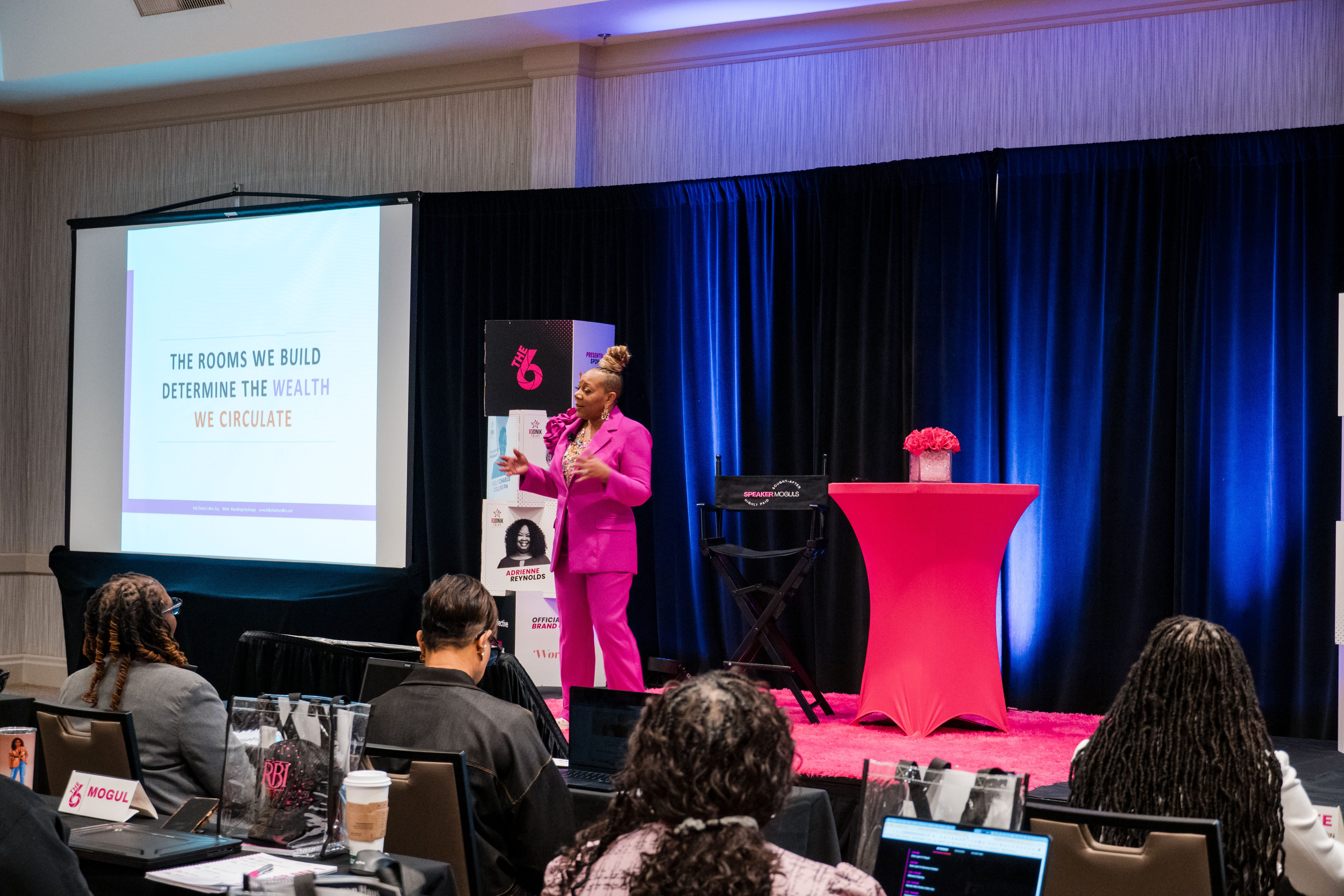
This is what I mean when I say “the rooms we build determine the wealth we circulate.”
I am not new to this work.
I am not learning it in public.
I am not performing it for an algorithm.
I have been doing this my whole career. Quietly. Without credit. Without announcement.
Because when one of us can’t walk through the door, the work is to make sure another one of us does.
That’s the story.
That’s always been the story.
There is another door I’m holding open right now. It’s called Octagon Haus — a private economic infrastructure for Black women experts who are ready to start circulating, compounding, and commanding their value. It’s invitation-only, and the Founding cohort is being curated now.
If you’ve read this far and something in you leaned forward — that’s the signal. Request an invitation at octagonhaus.com.
About the Author
Kelly Charles-Collins, Esq. is a founder, former trial attorney and law firm partner, and speaker known for bringing clarity, conviction, and strategic insight to conversations that matter. Her perspective was shaped in high-stakes environments where precision, presence, and the ability to communicate under pressure were required, not optional.
Today, she is often called into conversations around authority, leadership, communication, reinvention, and expertise-driven enterprise. She brings a rare combination of legal rigor, founder vision, and lived experience to stages, interviews, town halls, podcasts, and leadership platforms seeking more than performance. They want substance, perspective, and a voice that can hold the room.
Kelly’s Properties: